

Revised Converter Output Voltage Delay and Efficiency Drop Issue Inquiry (Innoswitch4-qr)
Posted by: dy08112
on
Hello,
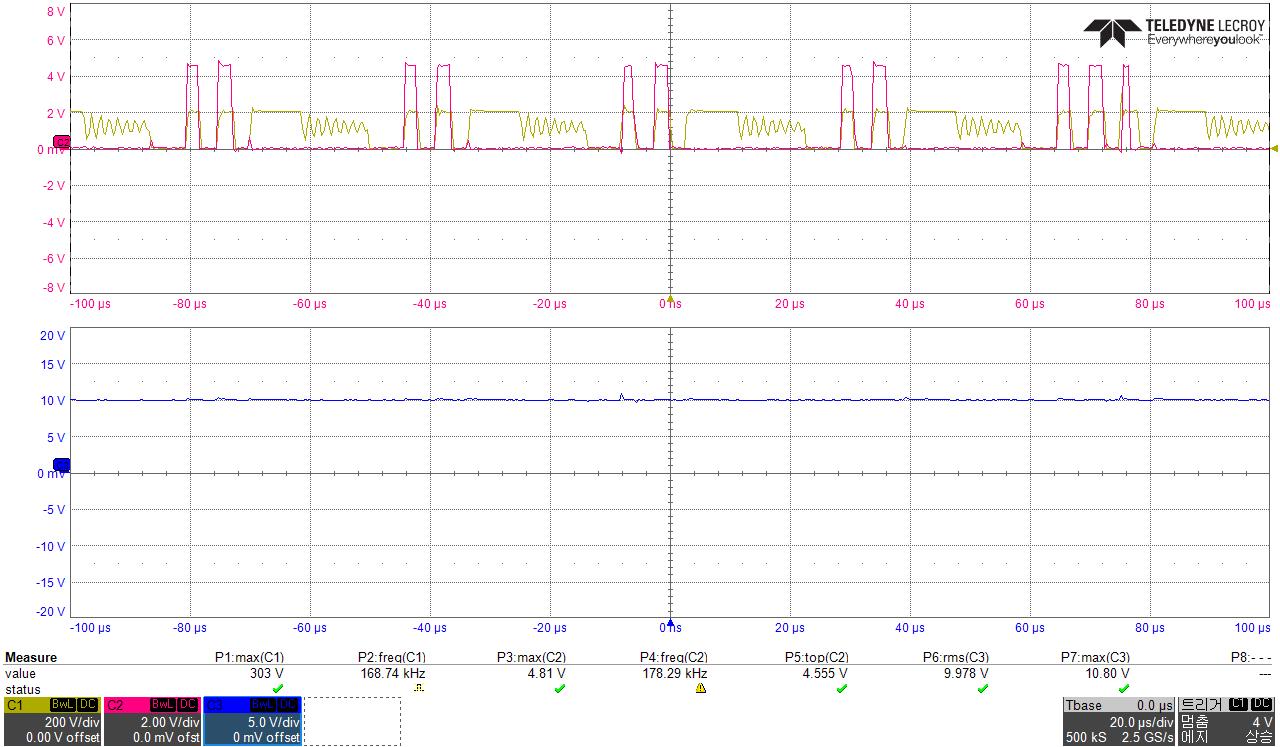
I am currently working to resolve an issue that occurred while designing a PCB based on the DER-993 reference. Under the operating condition of 85Vac input and a 60W load, the output voltage, which should be 12V, is only reaching 10V, and then gradually rises to 12V after about one minute. Additionally, while the efficiency was 90% under the previous test condition of 85Vac/42W, it dropped sharply to 84% when tested at 60W.
I measured the voltage at the feedback pin and found it to be 1.14V, which does not reach the required 1.25V. I suspect there may be an issue with the control circuit. Could you please provide any advice regarding this?
Files
Lecroy--00342 (85Vac, 30W).jpg
(143.16 KB)
Lecroy--00344 (85Vac, 42W).jpg
(142.7 KB)
Lecroy--00345 (85Vac, 60W).jpg
(142.45 KB)


Hi,
Good day. Thank you for choosing Power Integrations and for trusting our devices.
One possible reason the output voltage does not immediately regulate at 12 V is insufficient output capacitance. When output capacitance is too low, the output capacitor cannot store enough charge to maintain desired voltage when load demands. As a result, the output voltage drops, leading the feedback loop to respond slowly.
Since the feedback pin reflects the output voltage status, when the output voltage is lower than the expected value, the FB pin is below its regulation threshold as well.
Regarding the efficiency, the lower output voltage naturally leads to reduced efficiency. Another thing, the controller keeps switching or operates in high-frequency mode in an attempt to raise the output. After multiple switching cycles, the output capacitor gradually charges, allowing the controller to reach the regulation point. However, this also means higher switching losses, further reducing efficiency. Moreover, low output capacitance can lead to higher current ripple and increased RMS conduction losses.
To assess this further, please confirm the total output capacitance in your design so we can determine whether it's adequate.
Feel free to reach out if you have any questions or need additional support.
Thank you, and have a great day ahead!
Best regards,
Power Integrations, Inc.