

TNY284-290 Application Example: Resistor R15 not explained
We consider datasheet TNY284-290, the application example in figure 16. There is a resistor R15 that connects pin EN/UV with pin BP/M. The usage of the resistor is not described in the application example. As we understand this resistor is not necessary for any kind of feature.
Let us know why this resistor is inserted into the application example.
---
May it be that the datasheet has a typo in the sentence on page 8:
"Undervoltage lockout is configured by R5 connected between the DC bus and ENABLE/UNDERVOLTAGE pin of U1. When present, switching is inhibited until the current in the ENABLE/UNDERVOLTAGE pin exceeds 25 μA. This allows the start-up voltage to be programmed within the normal operating input voltage range, preventing glitching of the output under abnormal low voltage conditions and also on removal of the AC input."
R5 doesn't exist in the application example. R15 exists, but is not described.
Thank you very much.
댓글
Hello. I also have a question about undervoltage protection resistors.
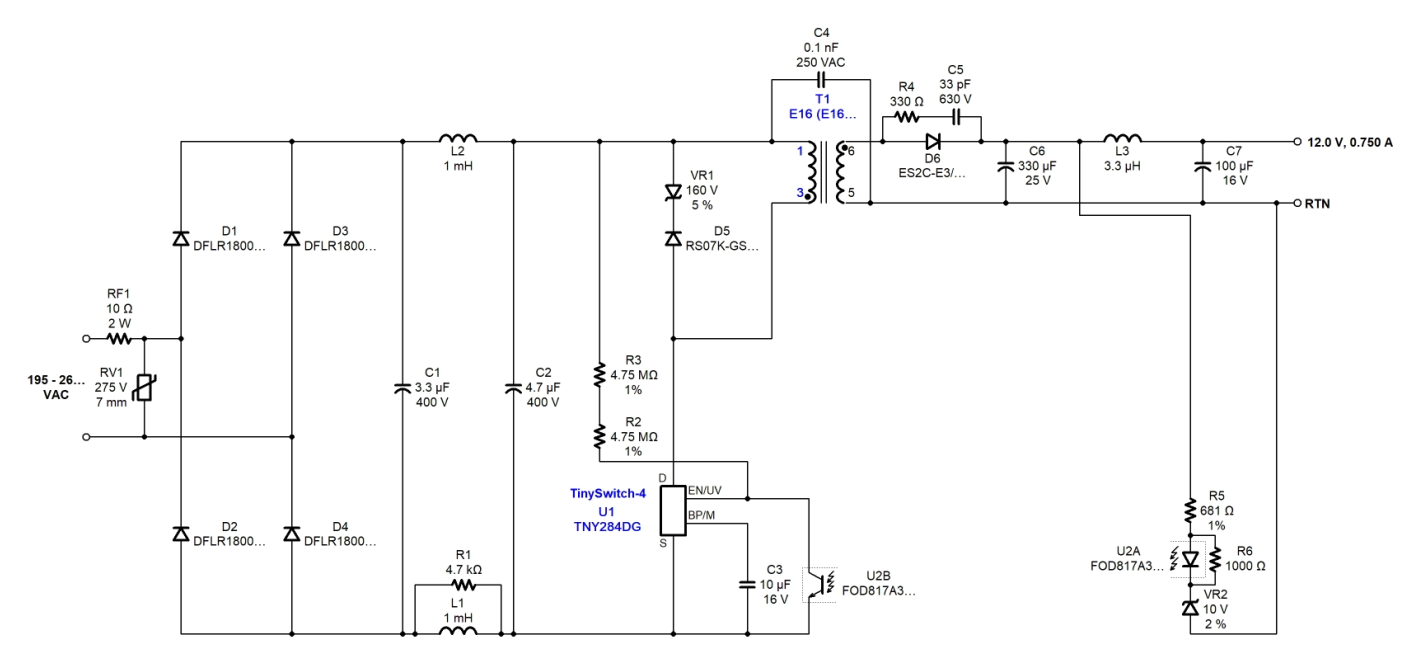
The circuit shown works perfectly. To optimize the circuit, I removed the optional resistors R3 and R2, and the microchip disabled undervoltage monitoring. What potential negative consequences could this have?
| 첨부 파일 | 파일 크기 |
|---|---|
| 1_9.png (151.46 KB) | 151.46 KB |
Hi,
The ENABLE/UNDERVOLTAGE pin senses line undervoltage conditions through an external resistor connected to the DC line voltage. If there is no external resistor connected to this pin, TinySwitch-4 detects its absence and disables the line undervoltage function.
Aside from this disabled function, there should be no other issues as long as it is designed well with our PI Expert tool. Please do the necessary test.
If you have further questions, please raise a request in our PowerPros Online Support Page: https://www.power.com/design-support/online-support-request
-Gavin


Hi fahmi,
Thank you for using PI product on your design. The explanation of R15 can be found on the below link, under UV Lockout section, pages 10-11. Thanks.
https://ac-dc.power.com/sites/default/files/PDFFiles/rdr295.pdf
Best Regards,
PI-SevenofNine